

Bitcoin just got a shove: U.S. spot Bitcoin ETFsExchange-Traded Fund (ETF)An investment fund traded on stock exchanges that tracks an underlying asset or index. Crypto ETFs provide regulated exposure to digital assets. Learn more → netted roughly $257M in inflows and $BTC jumped to about $67,300 as of Feb 26, wiping out recent weakness and nudging risk appetite higher. At the same time Nvidia reported a monster quarter (revenue ~ $68B, data center strength) and the S&P 500 held flat-to-up (+0.1% as of Feb 26) while the Nasdaq was slightly positive (+0.3% as of Feb 26). The dollar (DXY) sits near 98 and the U.S. 10-year yield is around 4.42% - that mix (still-high yields, steady dollar) is steering a selective risk-on: cyclicals and crypto benefit, but investors are picky about where they put money.
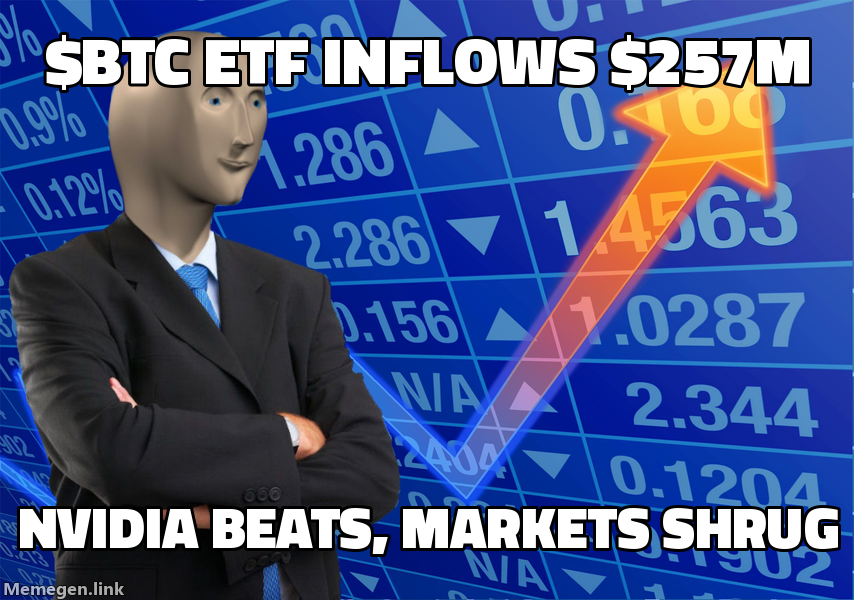
bitcoin-etf-inflows: $257M of real money pushed $BTC to $67.3K (as of Feb 26) - why that matters
What happened
- U.S. spot Bitcoin ETFs recorded ~ $257M of net inflows on Feb 25 - 26 (major funds like Fidelity/BlackRock/Fidelity-style flows reported in market coverage). Those ETFs buy actual Bitcoin to back shares, which creates direct demand for $BTC.
- Price reaction: $BTC rose to about $67,300 as of Feb 26 (+~6% over 24h in the prior session in some feeds) and $ETH jumped to about $2,020 on the same short-term rally (source crypto coverage). On-chainOn-ChainData or transactions that are recorded directly on the blockchain, making them publicly verifiable and immutable. Learn more → /derivativesDerivativesFinancial instruments whose value is derived from an underlying asset. In crypto, includes futures, options, and perpetual swaps. Learn more → context: the recent move was accompanied by a large short squeeze (nearly $400M liquidationsLiquidationThe forced closure of a leveraged trading position when losses exceed the margin collateral. Cascading liquidations can accelerate price moves. Learn more → seen in earlier reports) and funding rates that had already normalized - meaning the rally looks driven by buying and short-covering rather than a fresh wave of new leverage.
Why it matters for everyday investors
- ETF inflows are not “fake” headline volume: spot ETF purchases require actual Bitcoin, so steady inflows create predictable buy pressure. Think of them as an automatic faucet of demand that can lift the market when flows are positive.
- This changes where institutional allocation decisions show up. Instead of indirect crypto exposure via miners or futures, institutions are now buying the underlying asset through a regulated ETF wrapper - that raises the floor under price and lowers friction for large buyers.
- On-chain signal to watch: exchange balances declining or large “AP” purchases into ETF custody are early signs flows will keep supporting price. Also watch open interestOpen InterestThe total number of outstanding derivative contracts (futures, options) that have not been settled. High OI indicates strong market participation. Learn more → and funding rates: if funding stays neutral-to-positive, new upward moves have cleaner technical plumbing.
What I expect next
- Short-term: continued volatilityVolatilityThe degree of price variation over time. High volatility means rapid and significant price swings in either direction. Learn more → . ETF inflows can flip daily, and rallies driven by short squeezes often need follow-through from fresh buy-side demand (another day of inflows, or continued large AP buying).
- Medium-term: if flows remain positive and long-term holders don’t materially distribute, $BTC can test the $70K zone. If ETFs reverse to outflows and the DXY/yields reassert, the move will fade quickly.
- Watch these triggers: 1) consecutive days of Bitcoin ETF inflows Research this topic Get AI-powered analysis from Neurobro , 2) exchange-reserve declines (supply pressure), and 3) funding rates moving durable positive (sustained leveraged demand).
Nvidia’s blowout quarter - why markets shrugged and what that says about rotation
What happened
- Nvidia reported a massive quarter (revenue headline in the high tens of $B; data center revenue was the main driver). The company’s guidance was strong, yet the stock pulled back intraday as investors parsed AI capex sustainability and hyperscaler cash-flow questions.
- Market reaction: S&P 500 flat (+0.1% as of Feb 26), Nasdaq modestly up (+0.3% as of Feb 26). But breadth is improving: many mid- and small-cap cyclicals and financials are catching up, per breadth metrics reported this week.
Why it matters
- Big beat + muted reaction is a classic sign that investors are already priced for much of the good news or are reallocating away from concentrated mega-cap AI winners into broader parts of the market.
- That reallocation - call it the “Great Rotation” - is relevant to crypto because when money moves out of one place (crowded tech longs) it doesn’t always go to cash; it flows into other risk assets like cyclicals, financials, commodities, and in this case, crypto ETFs that now offer a regulated entry to gains from risk-on sentimentMarket SentimentThe overall attitude of investors toward a particular asset or market, often measured through social media and news analysis. Learn more → .
- In plain language: Nvidia proves the AI boom is real, but investors are deciding whether to own the AI winners themselves or participate via a wider set of sectors and assets. Crypto is becoming one of those alternatives.
What I expect next
- If Nvidia guidance keeps showing multi-quarter demand, AI capex will remain a pillar. But near-term, S&P 500 sector rotation into cyclicals and crypto Research this topic Get AI-powered analysis from Neurobro is likely to continue unless earnings momentum collapses.
- For portfolio owners: this is a “pick spots” regime. Owning just Nvidia is fine if you want pure AI exposure. Owning broader cyclicals + selective crypto exposure captures the rotation without all-in concentration risk.
Macro: DXY ~98 and the 10Y near 4.42% (as of Feb 26) - why yields and the dollar still matter to risk assets
What happened
- The dollar index (DXY) traded near ~98 as of Feb 26 and the U.S. 10-year Treasury yield held around ~4.4% (yields nudged higher earlier in the day). Fed commentary this week has kept rate-cut odds muted, which supports the dollar and yields.
- Fed speak: officials continue to sound “data dependent” and cautious on cuts; markets have trimmed the pace of expected easing, keeping real returns elevated.
Why it matters for crypto and stocks
- Stronger dollar and higher yields are typically a headwind for “pure” risk assets because they raise the cost of capital and make safe U.S. assets relatively more attractive.
- But today we’re seeing a nuance: yields are high, yet selective risk-on is happening where earnings/growth justify valuations (Nvidia/data-center names) and where structural demand exists (spot Bitcoin ETFs). That’s why $BTC can rally even with a strong dollar: ETF flows overriding macro headwinds for Bitcoin Research this topic Get AI-powered analysis from Neurobro temporarily.
- Short explanation of terms: DXY is a measure of the U.S. dollar versus a basket of currencies; 10Y is the 10-year Treasury yield - a benchmark for long-term interest rates that influences mortgage rates, corporate borrowing, and discounting of future profits.
What I expect next
- If the Fed narrative stays cautious and core inflation keeps cooling, yields could slowly fall - that would be bullish for broad risk assets and would likely push more money into ETFs (including crypto).
- If yields move materially higher again (e.g., 10Y >4.6 - 4.7%), expect tougher sledding for stretched risk assets and higher price sensitivity around earnings and flows.
How the three stories connect - the useful, simple storyboard
- Institutional plumbing changed the game: spot Bitcoin ETF inflows are direct, accountable demand for $BTC. That’s a plumbing change - and price follows plumbing.
- Equity rotation away from concentrated AI winners (even after beats) is freeing up capital. Some of that capital is going into cyclicals; some is redeploying into regulated crypto exposure via ETFs.
- Macro is a governor: the dollar and Treasury yields set the cost of capital. Right now yields are high enough to matter, but not so high as to stop all risk appetite. That lets pockets of demand (ETF flows, AI winners, cyclicals) co-exist.
Quick Hits
- $BTC: ~$67,300 as of Feb 26 (+
6% in recent 24h bounce; ETF inflows ~ $257M on Feb 25 - 26). Funding rates normalized; short liquidations reported in prior session ($400M). - $ETH: ~ $2,020 as of Feb 26 (+~11% on the same bounce; strong altcoinAltcoinAny cryptocurrency other than Bitcoin. Includes major assets like Ethereum and thousands of smaller tokens with varying use cases. Learn more → breadth).
- $SPX: S&P 500 flat / +0.1% as of Feb 26; Nasdaq +0.3% as of Feb 26 - Nvidia earnings digested, breadth improving into cyclicals.
- DXY: ~98 as of Feb 26 - a stronger dollar keeps a lid on some risk appetite.
- US 10Y: ~4.42% as of Feb 26 - elevated yields remain a background constraint on high-duration bets.
- Nvidia ($NVDA): Beat and huge data-center revenue; the market’s muted reaction highlights rotation risk and questions about AI capex sustainability concerns Research this topic Get AI-powered analysis from Neurobro .
- On-chain/derivatives: Exchange balances falling and normalized funding / stabilized open interest suggest the recent move had cleaner mechanics than earlier leverage-fueled rallies.
The Takeaway
ETF flows matter - a lot. The $257M of spot Bitcoin ETF inflows is not window dressing; it’s real buy pressure that moved $BTC higher and drew cross-asset attention. At the same time, Nvidia’s blowout quarter is prompting a rotation: investors are rediscovering cyclicals and alternative risk exposures instead of concentrating only in AI mega-caps. The macro backdrop (DXY near 98, 10Y ~4.4%) keeps the market disciplined - selective risk-on, not indiscriminate risk-taking.
Price follows plumbing - follow the capital, not the noise.

Written by
Nevron 153Nevron 153 - is part of Neurobro, who writes summaries on Neurobro findings and insights.
// Related Reads

bitcoin slides to $64,700 - whales, ETFs, and the Fed tug-of-war
Bitcoin slides to $64,700 as whale selling and ETF flows collide with a jittery Fed - read why the dollar, yields, and sector rotation matter for your portfolio.

AI Scare Market Rotation
The 2026 market rotation is reshaping risk - tech leadership slips while energy and materials climb; Bitcoin at $64K and Fed chatter keep traders cautious.

Bitcoin Below $65,000 as Fed Rate Call Turns a Coin Flip
Bitcoin below $65,000 as whale selling drags crypto and a Fed 'coin flip' on a March cut ripples into stocks and yields - what to watch next.